
Best Post Office Savings Schemes 2026: For many people seeking dependable, secure investment solutions, Post Office Savings Schemes have been the preferred option. The Indian Postal Service offers these initiatives as a safe way to increase your wealth. This article covers several Post Office Saving Plans available, their interest rates, and the benefits they provide. Post Office Schemes provide something for everyone, regardless of whether you’re searching for long-term savings or a steady income.

Post Office Savings Schemes: Tax Benefits and Interest Rates
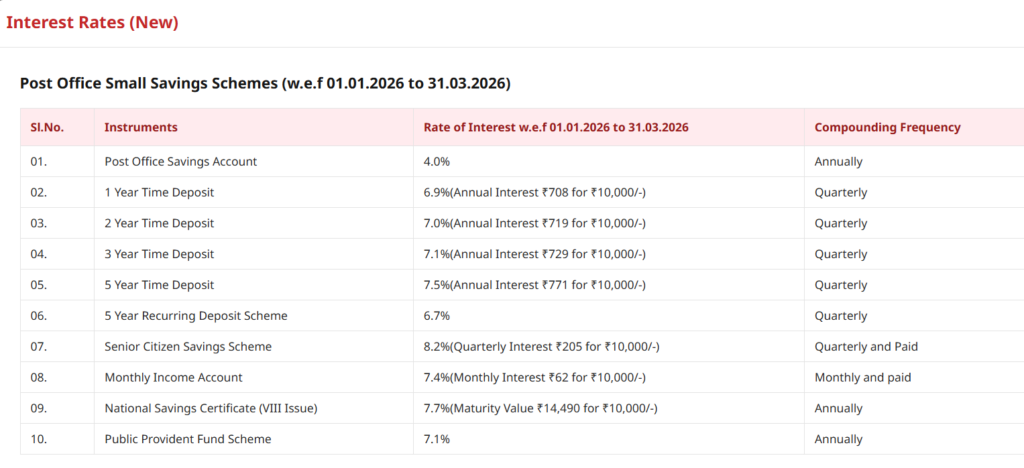
The Indian Post Office provides a range of savings plans with varying interest rates. Under the Income Tax Act of 1961, the amount invested and interest received on these savings plans are also eligible for several tax deductions. The varieties of Post Office Savings Schemes and the most recent interest rates for FY 2026–2027 are compiled in the following table.
| Scheme Name | Interest Rate | Minimum Investment | Tax Status |
| National Savings Monthly Income Account (MIS) | 7.4% (Compounded monthly and paid) | Rs. 1,000 | Taxable |
| Senior Citizens Savings Scheme Account (SCSS) | 8.2% (Compounded quarterly and paid) | Rs. 1,000 | Taxable |
| Public Provident Fund Account (PPF) | 7.1% (compounded yearly) | Rs. 500/year | Tax Benefits |
| Sukanya Samriddhi Account (SSA) | 8.2% (Annually compounded) | Rs. 250 | Tax Benefits |
| National Savings Certificates (VIIIth Issue) (NSC) | 7.7% (Annually compounded) | Rs. 1,000 | Tax Benefits |
| Kisan Vikas Patra (KVP) | 7.5% (Annually compounded) | Rs. 1,000 | Taxable |
| Mahila Samman Savings Certificate | 7.5% (quarterly compounded) | Rs. 1,000 | Tax Benefits |

Popular Post Office Savings Schemes to Consider in 2026
India Post offers a range of schemes, each suited to specific investment goals. Whether you want to save for the future, earn interest regularly, or build wealth for retirement, the following schemes remain essential in 2026:
Post Office Monthly Income Scheme (POMIS)
The Post Office Monthly Income Scheme (POMIS) is a trusted investment option officially endorsed by the Ministry of Finance. This scheme offers an impressive earning potential, offering an interest rate of 6.6%. The returns on this scheme are paid monthly. Once a POMIS account is opened, individuals can invest an amount that fits their financial capacity; however, it should be no less than ₹1500.
This option offers a low-risk way to generate consistent income, allowing investors to make monthly deposits and earn interest at the current applicable rate for the scheme at the post office. The relevant post office provides the monthly returns on your investment. The maximum tenure of the Indian Post Office Monthly Income Scheme is 5 years.
Public Provident Fund (PPF)
The Public Provident Fund (PPF) is a government-supported savings plan that offers assured returns and is tax-free. The interest rate holds steady at 7.1% per annum for the fourth quarter of the fiscal year 2025-26. Thanks to its sovereign security, compound interest, and EEE tax benefits, PPF stands out as a top choice for those looking to secure their retirement and improve their tax strategy in India.
You can open a PPF account at a Post Office or at any nationalised bank. Now, you can open PPF accounts using Aadhar-based biometric eKYC authentication. Additionally, starting from July 27th, 2026, you can conveniently deposit and withdraw funds using this paperless facility. The interest rate for the PPF for the fourth quarter (January-March) of FY 2025-26 will remain 7.1% per annum.
PPF needs a minimum of Rs. 500 and a maximum of Rs. 1.5 lakh annually, applicable to both employees and self-employed individuals. PPF contributions are exempt from tax up to Rs. 1.5 lakh each year, and both the interest accrued and the maturity amount enjoy full tax exemption. You can also take a loan against PPF after one year, allowing for up to 25% of the balance. Withdrawal from PPF starts partially after 5 years, and fully after 15 years.
National Savings Certificate (NSC)
The National Savings Certificate is a reliable investment option provided by the Government of India, designed to offer fixed returns over time. The maturity period for these accounts spans five years. The initial deposit required to open an account is ₹ 1,000, and any additional investments can be made in increments of ₹ 100. You can invest without any upper limit.
An adult has the option to open a National Savings Certificate account for themselves or on behalf of a minor. Children aged 10 and above are eligible to open an account. The program provides a secure return on investment. The prevailing interest rate on the National Savings Certificate is 7.7%. NSC is eligible for deductions under Section 80C up to ₹1.5 lakh, and interest is compounded annually and returned on maturity. Remember that with NSC, you cannot opt for periodic payments.
Senior Citizens Savings Scheme (SCSS)
The Senior Citizen Savings Scheme is a government-supported retirement savings option for individuals aged 60 and over. Individuals who meet the criteria can invest from Rs. 1000 to Rs. 30 lakh for a duration of 5 years, earning an interest rate of 8.2% per annum under the SCSS scheme. You can claim a deduction on the principal amount invested under section 80C of the Income Tax Act, with a limit of Rs. 1.5 lakhs.
The payment amount varies from ₹1,000 to ₹15 lakhs. This sum is limited to the retirement benefits. It is essential to deposit into the Senior Citizen Scheme account within a month of receiving retirement benefits from your employer. Additionally, if a person deposits more than the specified amount, the excess funds will be returned to the account holder. The duration is set at 5 years, with the option to extend for an additional 3 years.
Sukanya Samriddhi Yojana (SSY)
Sukanya Samriddhi Yojana (SSY) is a specialised savings initiative aimed specifically at benefiting the girl child. Parents or legal guardians have the opportunity to establish an SSY account for their daughter from the moment she is born until she turns 10 years old. The plan mandates a minimum yearly deposit of ₹250, with a maximum annual contribution of ₹1.5 lakh. The Sukanya Samriddhi account matures at 21 years after it is opened, but contributions are required only for the initial 15 years.
Parents and guardians can find this scheme especially appealing due to the tax exemptions offered under Section 80C of the Income Tax Act. The online facility for the Sukanya Samriddhi account has significantly enhanced availability for parents throughout India. The current competitive interest rates set by the Government of India are at 8.2% per annum for FY 2025–26, offering a notable advantage over various other savings alternatives in the market.
Kisan Vikas Patra (KVP)
Kisan Vikas Patra is a fixed-income instrument in which investors buy certificates with a predetermined maturity period; upon maturity, they provide a return that doubles the original investment. The KVP scheme offers a consistent interest rate, making it a secure investment choice. This option is perfect for those seeking reliable returns while keeping risk to a minimum. KVP promotes financial discipline and provides liquidity, with the option to withdraw early after a 2.5-year lock-in period.
Currently, the interest rate for KVP is 7.5% per annum, compounded annually. The maturity period for KVP is 115 months, roughly 9 years and 7 months. This extended timeframe promotes consistent saving and the gradual building of wealth. KVP is intended for those looking to invest over the long haul, but you can cash out early after a 2.5-year (30-month) lock-in period.
Mahila Samman Savings Certificate (MSSC)
The Mahila Samman Saving Certificate (MSSC) is an innovative small savings scheme introduced in the Budget 2023 to encourage women to invest. The Mahila Samman savings scheme offers a unique opportunity, with a fixed 2-year duration, for participants to benefit from its features.
The plan provides a consistent interest rate of 7.5% annually, which will remain unchanged throughout the term. The time frame was just 2 years, making it ideal for short-term financial planning. After one year from the date of account opening, account holders have the option to withdraw as much as 40% of their account balance. A minimum deposit of ₹1,000/- is required, with additional amounts accepted in multiples of 100, up to a maximum limit of ₹2,00,000/-.

Choosing the Right Post Office Scheme in 2026
As you look at Post Office Savings Schemes in 2026, it’s important to ensure that your investment decisions are in sync with your financial objectives. If you’re seeking a consistent income stream, the Monthly Income Scheme or the Senior Citizens Savings Scheme is an excellent option. For sustainable growth while enjoying tax advantages, PPF is an outstanding choice. If you’re aiming to double your investment over time, Kisan Vikas Patra might be an excellent option.
Before making any investment decisions (Post Office Savings Schemes) evaluate your comfort with risk, the period of time you plan to invest, and the tax advantages that match your financial circumstances. Consulting a financial advisor is a wise choice if you’re unsure which plan suits your needs.